Inside the Bindery: How Our Journals Are Made
Behind the Scenes · Apr 15, 2026 · 7 min read
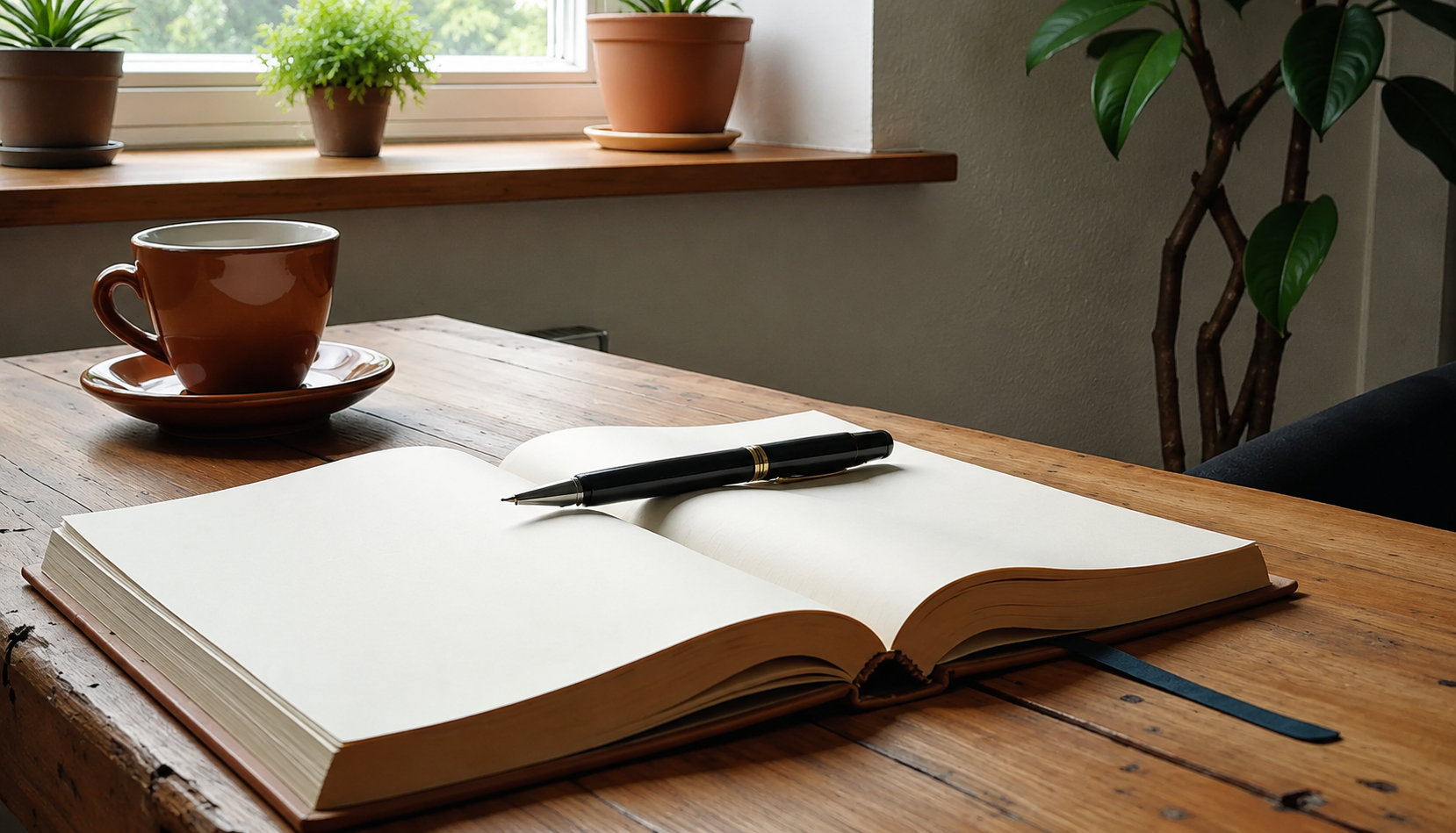
There is a distinct, grounding silence that fills a bindery. It is not the empty silence of an abandoned space, but the focused, rhythmic quiet of artisans at work. Here, the modern world slows down, yielding to the steady hum of a bone folder smoothing out a crease, the crisp slice of a heavy-gauge paper cutter, and the gentle whisper of linen thread pulling through folded paper. In an era dominated by fleeting digital interactions and disposable objects, we choose a different path. We believe that the objects you carry should have a soul.
The Philosophy of Intentional Design
Before a single sheet of paper is cut, our journals exist as a series of deliberate design choices. To us, minimalism is not the absence of design; it is the absolute optimization of it. It is the subtraction of the unnecessary until only what is essential and beautiful remains. We begin by asking how a journal will feel in your hands on a quiet Tuesday morning, or how it will lie flat on your desk while you sketch out your next big idea. Every dimension, weight, and texture is calculated to eliminate distraction, allowing your mind the ultimate freedom to create. Our aesthetic rejects the loud and the ornamental. The luxury of our journals lies entirely in the quality of the raw materials and the precision of the construction.
Sourcing with Conscience: The Raw Materials
A masterful journal requires an uncompromising foundation. Our sourcing process is rigorous, guided by two unyielding pillars: sensory perfection and environmental responsibility.
The Paper: We source our text blocks from historic European mills that utilize certified sustainable forestry practices. The paper we selected is a heavy, acid-free archival stock with a subtle cream hue that mimics natural light, drastically reducing eye strain during long writing sessions. It possesses a gentle, toothy texture — just enough resistance to make writing a tactile pleasure. Because it is acid-free, your words will not yellow or degrade over time.
The Covers: For our covers, we utilize two distinct materials. Vegetable-Tanned Leather: Our leather is sourced from a family-run Italian tannery that uses natural plant extracts instead of harsh chemicals. This traditional process allows the leather to retain its natural markings and develop a rich, unique patina over time. Premium European Bookcloth: For our vegan-friendly options, we select tightly woven, archival-grade bookcloth. It offers a clean, architectural look and a satisfyingly crisp feel.
Step 1: The Art of the Fold and the Signature
The physical journey of a journal begins with large, flat sheets of archival paper. These sheets must be transformed into "signatures" — the small, multi-page booklets that form the backbone of a book. Accuracy at this stage is paramount. Our artisans fold the sheets by hand, using a traditional bone folder — a smooth, polished tool made of natural bone or dense Teflon. These folded sheets are then nested together into signatures. A standard journal consists of several of these signatures stacked precisely on top of one another.
Step 2: The Smyth Sewn Binding — Built to Lie Flat
One of the most frustrating experiences for a writer or artist is fighting a journal that constantly tries to snap shut. To solve this, we employ the historic Smyth sewing technique. Signatures are meticulously stitched together using a specialized industrial sewing machine, reinforced by hand-stitching at the head and tail. We use a high-tensile, waxed linen thread that flexes naturally with use. Because the signatures are bound together by thread rather than a rigid wall of adhesive, the journal achieves a perfect 180° lay-flat behavior. Whether you are writing on the first page, the exact middle, or the very last leaf, the book lies completely flat against your desk.
Step 3: Preparing the Block and Trimming
Once the signatures are securely sewn, they form what binders call the "book block." The spine of the block is lightly coated with a flexible, archival-grade PVA adhesive. After the adhesive dries, the book block moves to our heavy guillotine cutter. With a single, powerful, clean slice, three sides of the book block are trimmed. The result is a perfectly flush, velvet-smooth edge.
Step 4: Crafting the Case
While the book block is being prepared, another artisan is working on the "case" — the protective outer cover. For our hardbound journals, this involves wrapping our chosen bookcloth or leather around dense, recycled binders board. The material is cut with exact margins, and the corners are meticulously mitered — cut at precise angles — so that when they are folded over the board, they meet in a seamless, flat joint.
Step 5: Casing-In and the Final Press
The final assembly is a marriage of two distinct parts: the book block and the case. The artisan applies a thin, even layer of adhesive to the endpapers. The block is then carefully dropped into the waiting cover. This requires an incredibly steady hand and a sharp eye; the book block must sit perfectly centered within the cover. Once aligned, the journal is placed into a traditional book press. Under immense, even pressure, the journal sits for several hours. This pressing stage ensures that the adhesive cures smoothly without warping.
Quality Control: The Human Touch
In our bindery, there are no conveyor belts, and there is no automated packaging line. Every single journal is inspected by a human being before it is cleared for our shelves. We open every book to check the tension of the spine. We run our fingers along the edges to ensure the trim is flawless. If a journal possesses even a microscopic flaw, it is sent back to be corrected. This obsessive attention to detail means our production numbers are low, but the lifespan of our products is incredibly high.
A Companion for Your Lifework
"Simplicity is the ultimate sophistication." — Leonardo da Vinci
When you hold one of our journals, you are holding hours of quiet dedication, centuries of bookbinding tradition, and a deep respect for raw materials. The minimalist exterior is designed to fade into the background, becoming a quiet canvas that reflects whoever you are and whatever you choose to write inside it. It does not demand your attention with loud graphics or trendy features. Instead, it invites you to slow down, uncork your pen, and engage with the blank page. It is built to accompany you through late-night ideas, morning reflections, sketches, travel notes, and life-changing plans.
Ready to experience it yourself?
Each journal is crafted by hand, built to last, and waiting to hold your story.
Shop the Collection